Economic outlook and forecasts Decoding Asian luxury consumers

December 2025 – Affluent consumers represent a relatively small portion of the global population, but their impact on spending is disproportionately large—accounting for an estimated one of every four dollars spent in 2024.¹ These consumers are also more likely to make cross-border purchases, engage with premium brands, and remain loyal if their expectations are met. Asia Pacific stands out as a particularly dynamic market in this regard. With rapid rises in consumer incomes across key economies, the region has seen a substantial expansion in both the volume and diversity of luxury purchases. By 2030, the number of affluent households (those earning over $200,000* per year) in Asia Pacific is expected to increase at an 8 percent compounded annual growth rate—the fastest pace of any region.²
However, this growth story is layered with complexity, with different economic factors and consumer preferences across the region creating opportunities, as well as challenges for businesses looking to capture this market. Based on an analysis of Visa’s anonymized transaction data, we found that Asia Pacific’s luxury market is set for rapid expansion over the next five years, driven by emerging affluent consumers and ‘aspirational’ buyers whose spending is highly elastic and shaped by cultural differences. To reach these consumers, merchants will likely be most successful when tailoring their promotions to reflect those differences. Collaboration across the luxury ecosystem to create bundled offerings will also help merchants to meet a variety of country-specific preferences as the market rapidly evolves.
Mainland China and Japan will remain Asia’s largest luxury markets in 2030, while India will grow the fastest
Domestic luxury spending in 2030 ($ billion); percentage change in spending in 2023-30
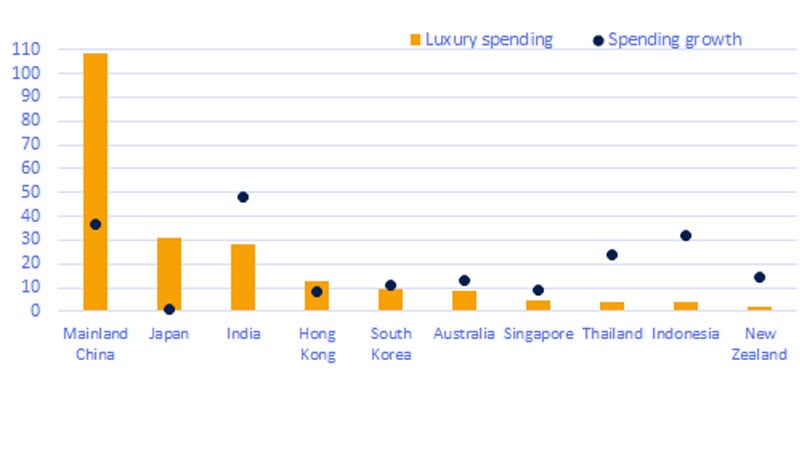
Asia’s luxury boom puts Mainland China and India in pole position
We have applied elasticity-driven spending growth to projected income increases to estimate luxury spending in 2030 across key Asian markets. (figure above) Our analysis suggests that Mainland China and Japan will together account for nearly 70 percent of the region’s total luxury spend over the next five years. Mainland China will continue to be the driving force and the region’s biggest market, worth $108 billion. Despite being Asia’s second-largest luxury market, worth about $31 billion in 2030, Japan will see the slowest pace of growth in spending, underlining the market’s maturity. We expect Singapore and Hong Kong to also grow in single digits, while other markets with established luxury consumer bases —Australia, New Zealand and Singapore—will see growth rates below 15 percent. Outside of Mainland China, we expect luxury spending growth to be driven by developing Asian markets of India, Indonesia and Thailand, even though the three countries will together account for only about 15 percent of the region’s total spend. At about 48 percent, India will see the fastest growth in spending by 2030, helped by a rapid increase in the number of affluent households. Indonesia and Thailand are set for over 24 percent growth, also reflecting an increasing appetite among consumers for premium experiences and goods.
However, capturing the attention and wallets of this diverse range of consumers is no easy task. In general, luxury is considered to have elastic demand, meaning demand rises sharply as income grows (and vice-versa). However, our analysis shows that this broad characterization hides an important subtlety—it varies substantially across income bands. Moreover, it can be affected by variables, ranging from soft and more subjective factors, like consumer confidence and cultural values to data-driven triggers like exchange rates. For instance, some markets show a faster increase in luxury spending with growing affluence, while others are more conservative. For issuers and merchants targeting affluent Asian consumers, it is important to understand these nuances to identify the right opportunities.
Aspirational buyers pose the biggest opportunity
Leveraging anonymized Visa transaction data, our analysis of affluent consumers’ purchasing behaviors revealed an interesting trend: As people get wealthier, luxury spending keeps climbing—but the rate of increase slows. (See Figure 2 in linked report)
- Aspirational buyers (those spending less than $20,000 annually) display high elasticity—an increase in total spending leads to a greater-than-proportional jump in luxury consumption. For example, for consumers spending under $10,000 annually in Australia, a 1 percent rise in overall card spending translates into 1.1 percent rise in luxury spending. In Singapore, the same consumer group is likely to increase their luxury spend by 1.2 percent, meaning that an entry-level buyer in Singapore will be more inclined to buy a luxury item, if they have extra money. (See related report from Visa Business and Economic Insights, “Luxury shopping is no longer just for the affluent.”)
- On the other hand, affluent consumers (those spending over $100,000 annually) exhibit much lower elasticity. The same 1 percent increase in total spend generates only about 0.6 percent increase in luxury spend among this group in both countries.
Beyond income, culture also determines propensity to spend
While income is a primary driver of luxury spend across Asia Pacific, the precise threshold at which the rate of increase in spending, relative to income, slows differs by market. For example, in Australia, elasticity starts falling beyond the $50,000 spend level, while for Thailand it is at the $10,000 level, reflecting the former’s likely strong social incentives for display of wealth. Cultural influences play a big role in this. When we compare the enthusiasm to spend extra income on luxury with a measure of individualistic³ versus collectivist tendencies in a society, we find that societies where personal autonomy and self-expression are prized tend to see a greater rise in luxury spending as incomes increase. For example, Australia and New Zealand have the highest individualism scores (over 60) and also the highest luxury spend elasticity (above 1). (See Figure 3 in linked report) This suggests a strong preference among consumers for personal indulgence. When catering to such groups, marketing strategies need to focus on exclusivity, status and the aspirational nature of luxury ownership.
Conversely, in collectivist societies, where social harmony and group approval are emphasized, luxury spending is more restrained and often motivated by community standing rather than personal enjoyment. For example, India and Indonesia have low scores for individualism as well as luxury spend elasticity. These consumers tend to be more conservative, even as disposable incomes grow. Here, businesses may need to offer targeted aspirational marketing and options that are more understated or designed for enjoyment in private settings. Interestingly, Singapore and Mainland China have lower individualism scores than South Korea and Japan, but higher luxury spend elasticities. This suggests strong aspirational tendencies among consumers in Singapore and Mainland China, who are more likely to splurge on luxuries if their incomes rise.
Australians spend on hotels, Chinese on experiences
Another interesting trend that comes up in our research is that wealthier consumers (such as those in Australia, Japan and New Zealand) prefer to shop in person when buying luxury items overseas. This suggests that they are not only looking for exclusive products, but also a memorable experience. Ensuring high-quality, attentive service to these consumers will be a good way to win their loyalty and business. Given that affluent consumers are increasingly responsible for a large share of travel spending, it is worth considering what Asians are buying when travelling internationally. Mature markets like Australia and Japan see luxury spending as a substantial proportion of total payment volume, with categories like travel, retail goods and entertainment serving as key drivers.
Our analysis of VisaNet data on outbound spend by Asian travelers shows that Indonesians, Australians and Japanese allocate the largest proportion of their travel spend to lodging compared with other countries, with high-end accommodation providers uniquely positioned to cater to their needs. Chinese consumers, who were once big on shopping while travelling, now tend to splurge on cultural and sports experiences as well as recreational activities instead. On the other hand, travelers from India still shop when abroad, presenting opportunities for travel and retail partners to collaborate on their offerings as the luxury market continues to evolve.
As Asia Pacific’s luxury market continues to grow, cultural nuances and income elasticity will redefine consumer engagement. Market growth will not be uniform: aspirational segments in emerging economies will drive volume, while mature markets will require differentiated strategies to sustain share. Entry-level luxury offerings, experiences that resonate locally and cross-sector collaborations can help brands build loyalty among future big spenders. As competition intensifies, those who combine data-driven insights with tailored propositions will be best positioned to capture the region’s next wave of luxury demand.
Footnotes
- Visa Business and Economic Insights. (July 2025) Affluent consumers set to drive global travel amid slowing world economy.
- Same as above
- @copyright The Culture Factor Group. Individualistic Countries.
Forward-Looking Statements
This report may contain forward-looking statements within the meaning of the U.S. Private Securities Litigation Reform Act of 1995. These statements are generally identified by words such as “outlook”, “forecast”, “projected”, “could”, “expects”, “will” and other similar expressions. Examples of such forward-looking statements include, but are not limited to, statements we make about Visa’s business, economic outlooks, population expansion and analyses. All statements other than statements of historical fact could be forward-looking statements, which speak only as of the date they are made, are not guarantees of future performance and are subject to certain risks, uncertainties and other factors, many of which are beyond our control and are difficult to predict. We describe risks and uncertainties that could cause actual results to differ materially from those expressed in, or implied by, any of these forward-looking statements in our filings with the SEC. Except as required by law, we do not intend to update or revise any forward-looking statements as a result of new information, future events or otherwise.
Disclaimers
The views, opinions, and/or estimates, as the case may be (“views”), expressed herein are those of the Visa Business and Economic Insights team and do not necessarily reflect those of Visa executive management or other Visa employees and affiliates. This presentation and content, including estimated economic forecasts, statistics, and indexes are intended for informational purposes only and should not be relied upon for operational, marketing, legal, technical, tax, financial or other advice and do not in any way reflect actual or forecasted Visa operational or financial performance. Visa neither makes any warranty or representation as to the completeness or accuracy of the views contained herein, nor assumes any liability or responsibility that may result from reliance on such views. These views are often based on current market conditions and are subject to change without notice.
Visa’s team of economists provide business and economic insights with up-to-date analysis on the latest trends in consumer spending and payments. Sign up today to receive their regular updates automatically via email.