Economic outlook and forecasts Regional growth slows amid falling real income gains
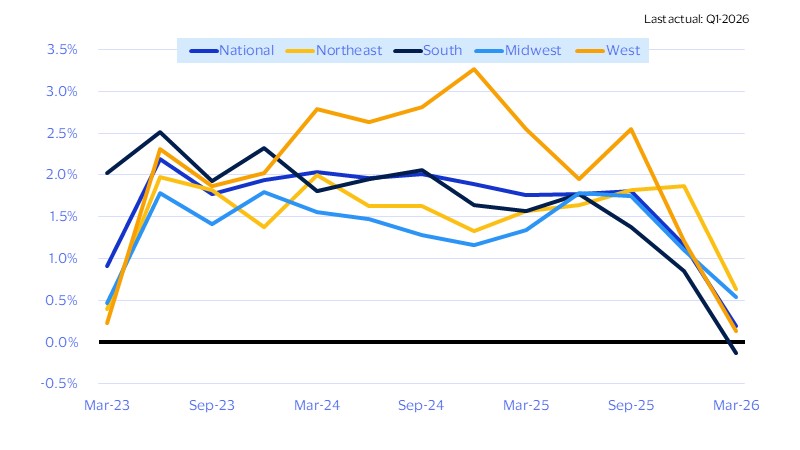
Inflation-adjusted per capita income growth has slowed
Real per capita income growth by region (YoY percent change)
Growth slows as structural headwinds in the Northeast outweigh investment tailwinds
The Northeast remains one of the more resilient regions in the country, but its growth outlook has softened meaningfully. While the region continues to benefit from its concentration of high-value industries, world-class research institutions, and expanding investment in AI and advanced manufacturing, a combination of demographic pressures, weaker labor force growth, elevated business costs, and heightened economic uncertainty has led to a significant downward revision in real GDP growth for the region.
New York, New Jersey, Massachusetts, and Connecticut have the largest downward revisions to their growth outlooks, reflecting constraints from aging populations, domestic out-migration, and slower international immigration. These larger states, along with smaller states like Rhode Island, Vermont, and Maine, all face labor-force constraints that are limiting hiring and reducing economic growth potential. Several of the Northeast’s traditional growth engines have also weakened. Technology and biotech hiring remain subdued in Massachusetts, financial-services hiring is slowing in Connecticut and New Jersey, and softer tourism and international travel are weighing on New York and northern New England. Additionally, elevated housing, energy, and business costs are creating additional headwinds across the region. Still, important investment-driven offsets remain. New York continues to benefit from major semiconductor investments, including Micron and GlobalFoundries, while Pennsylvania is emerging as a leading destination for AI, cloud computing, and digital infrastructure investment. Defense-related manufacturing in Connecticut, Maine, and New Hampshire, along with the region’s large healthcare and life-sciences footprint, should continue to support growth.
In the near term, the Northeast’s consumer spending growth is expected to lead all other regions thanks in large part to a high share of employment in high-income sectors like finance and banking. Connecticut, New York and New Jersey have a particularly high concentration of employment in these sectors, which will likely support strong consumer spending growth in those states. However, we anticipate much more modest consumer spending growth in 2027 relative to 2026, as there are no major changes to tax liability expected next year. Overall, the Northeast is expected to remain relatively resilient, but growth is likely to moderate. While a concentration of affluent consumers, strong tourism and advanced manufacturing investment are likely to buoy growth, slower labor-force expansion and elevated costs are likely to weigh on future growth.
Higher energy prices boost growth but raise costs across the South
The South remains one of the fastest growing regions in the U.S., though growth is becoming increasingly uneven as slowing migration weighs on some states and higher energy prices create both opportunities and challenges. Population growth across the South continues to moderate overall, with migration trends varying by state. Florida's post-pandemic migration boom has cooled, contributing to a normalization in housing market conditions and economic growth.¹ Elsewhere, however, strong inflows of households and businesses continue to support economic momentum. Tennessee's record number of business filings, the highest in the state's 33-year history of tracking, underscores its ongoing appeal as a destination for both firms and residents.²
Higher energy prices provided an opportunity for several Southern states during Q2-2026. Energy-producing states such as Louisiana, Texas, and Oklahoma benefited as rising oil prices increased the value of existing production assets and supported broader economic activity. This created a short-term boost to growth during the quarter, particularly through stronger investment and capital spending.³ However, the benefits are unlikely to be permanent, and we expect the impact of higher oil prices to gradually fade in early 2027. The energy industry continues to face long-term challenges and remains far less labor-intensive than in previous decades. While energy firms significantly increased capital expenditures during Q2-2026, expected expenditures for next year remained largely unchanged, suggesting continued caution regarding the longer-term outlook.
While higher energy prices benefited select states, consumers across the South faced the opposite effect through rising fuel costs. The price of a regular gallon of gasoline in Gulf Coast states rose nearly 29 percent YoY in July, among the fastest increases across major U.S. regions.⁴ At the same time, the region is also prone to some of the sharpest declines when prices adjust. Because many states impose relatively low gasoline taxes, retail fuel prices tend to more closely reflect volatility in underlying oil markets. The South remains one of the country’s strongest growth regions, but performance is becoming increasingly tied to state-specific dynamics. As migration normalizes and the benefits of higher oil prices gradually fade, long-term growth will depend more heavily on each state’s ability to attract residents, businesses, and investment.
Healthcare keeps the Midwest expanding amid manufacturing woes
The Midwest's economy ran hotter to start 2026, with regional GDP growing 2.6 percent YoY in the first quarter, up from 2 percent in the previous quarter. However, payrolls contracted for the second consecutive quarter even as overall growth accelerated. Going forward, we expect growth in the Midwest to slightly underperform the nation in 2026. Healthcare remains the region's most dependable growth engine. Minnesota's hospital and advanced-therapy sector is in the middle of a multibillion-dollar expansion cycle, including new cancer-treatment facilities slated to open this year,⁵ and Indiana continues to draw a growing cluster of biotech and pharmaceutical investment near Indianapolis. The pattern holds in other states: healthcare has driven a significant share of the recent private-sector job growth in Michigan and a large share in Ohio, helping to cushion against weaker growth in manufacturing jobs. That tailwind is fading at the margins, though, as Medicaid funding cuts and the expiration of enhanced Affordable Care Act subsidies begin squeezing hospital finances in Ohio, Missouri and Michigan.
Manufacturing is stabilizing in places but remains the region's biggest structural drag. Wisconsin's factory payrolls are growing again after several years of decline, and Illinois landed one of the region's largest factory-job announcements in years when a trailer manufacturer said it would add roughly 2,500 positions at a new plant near Chicago.⁶ But the region's dominant auto sector is still reeling. Michigan's transportation-equipment payrolls are also declining as weak electric vehicle demand and elevated vehicle prices weigh on the U.S. electric vehicle market, and tariffs on steel, aluminum and vehicle parts continue to squeeze margins.
Agriculture is also under strain. Elevated fertilizer and diesel costs are compounding a difficult year for crop farmers already contending with soft row crop prices and stiff competition from Brazilian exports. Livestock producers are the exception: record-low cattle inventories have pushed beef prices to historic highs, a bright spot for states like Nebraska.
We expect the Midwest to keep growing more slowly than the rest of the country. Healthcare and pockets of manufacturing investment concentrated in Minnesota, Indiana and Ohio will keep the region from stalling out, but persistent weakness in agriculture and trade-exposed manufacturing will leave the region lagging the overall nation.
The West leads, but momentum will moderate
Much like the Midwest, the West's economy also picked up steam to start 2026, with regional GDP growing 3 percent YoY in the first quarter, a significant uptick from 2 percent in the previous quarter and comfortably ahead of the nation overall. Job growth accelerated too, rebounding from a stall out during the second half of 2025. Semiconductor investment, migration into the Mountain West, and steady defense spending should keep the region at the top of the national rankings in terms of economic growth in 2026.
The AI boom is showing up more in capital spending than in payrolls across the region's coastal tech hubs. In Washington, the firms anchoring the world's leading cloud platforms have leased sprawling new office space even as they trim jobs. California's tech sector faces a similar split: software and IT equipment spending are surging, yet employment remains below its pre-pandemic peak. The story is different in the region's chip corridor, where federal and private investments in semiconductor infrastructure are actively transforming local economies. Spearheaded by multibillion-dollar megaprojects across Arizona and Idaho, this sweeping domestic chip expansion is driving local development and creating thousands of high-wage advanced manufacturing and engineering roles.
Migration remains the region's dividing line. Arizona, Utah, Idaho and Nevada continue to rank among the nation's fastest-growing populations, drawing residents and investment with lower costs and expanding job markets; in Nevada, that growth increasingly shows up in nonresidential construction and logistics tied to data centers and battery manufacturing. California and Oregon, by contrast, remain hobbled by weak domestic migration and high living costs, while New Mexico and Alaska face outright population declines alongside cuts to federal employment.
A spike in oil prices tied to the conflict in the Middle East and the closure of the Strait of Hormuz is cutting both ways. Energy producers in Wyoming, Alaska and New Mexico are getting a temporary lift to output and government revenue, but the same price surge is raising fuel and airfare costs just as tourism was already softening in Hawaii and Las Vegas. The West should remain the nation’s strongest-growing regional economy through 2026, carried by semiconductor investment and migration-driven growth in the Mountain West. But that edge is set to narrow in 2027 as tech investment matures and energy costs weigh on tourism and agriculture.
Footnotes
- Visa Business and Economic Insights and Florida Chamber of Commerce, 2026 Florida Economic & Business Mid-Year Report – Florida Chamber of Commerce
- Visa Business and Economic Insights and Tennessee Secretary of State’s Office, Tennessee Secretary of State Announces New Records in Business Filings, While Population Growth Stays Strong | Tennessee Secretary of State
- Visa Business and Economic Insights and Federal Reserve Bank of Dallas, Oil and gas expansion gains momentum; outlooks improve but cost pressures grow - Dallasfed.org
- Visa Business and Economic Insights and U.S. Department of Energy
- Visa Business and Economic Insights and Minnesota Oncology
- Visa Business and Economic Insights and Illinois Governor’s Office, Gov. Pritzker Announces Hyundai Translead to Bring 2,500 Jobs to Illinois
Forward-Looking Statements
This report may contain forward-looking statements within the meaning of the U.S. Private Securities Litigation Reform Act of 1995. These statements are generally identified by words such as “outlook”, “forecast”, “projected”, “could”, “expects”, “will” and other similar expressions. Examples of such forward-looking statements include, but are not limited to, statements we make about Visa’s business, economic outlooks, population expansion and analyses. All statements other than statements of historical fact could be forward-looking statements, which speak only as of the date they are made, are not guarantees of future performance and are subject to certain risks, uncertainties and other factors, many of which are beyond our control and are difficult to predict. We describe risks and uncertainties that could cause actual results to differ materially from those expressed in, or implied by, any of these forward-looking statements in our filings with the SEC. Except as required by law, we do not intend to update or revise any forward-looking statements as a result of new information, future events or otherwise.
Disclaimers
The views, opinions, and/or estimates, as the case may be (“views”), expressed herein are those of the Visa Business and Economic Insights team and do not necessarily reflect those of Visa executive management or other Visa employees and affiliates. This presentation and content, including estimated economic forecasts, statistics, and indexes are intended for informational purposes only and should not be relied upon for operational, marketing, legal, technical, tax, financial or other advice and do not in any way reflect actual or forecasted Visa operational or financial performance. Visa neither makes any warranty or representation as to the completeness or accuracy of the views contained herein, nor assumes any liability or responsibility that may result from reliance on such views. These views are often based on current market conditions and are subject to change without notice.
Visa’s team of economists provide business and economic insights with up-to-date analysis on the latest trends in consumer spending and payments. Sign up today to receive their regular updates automatically via email.