Business and tech innovations How AI is reshaping who becomes an entrepreneur

October 2026 – Every major technology has reshaped the economy through the people and businesses that turn it into new products and markets, unlocking new waves of productivity gains, wealth accumulation and growth. Electricity and semiconductors followed this path. GenAI will be no different.
In fact, GenAI is arriving as broader societal changes are already changing how people think about work, careers and entrepreneurship. The “who” in the untold story of AI’s diffusion could be a different cast: millennials now moving through their 30s and 40s. Many have spent years building industry knowledge, professional networks, and a clear understanding of customer problems. That puts them at a natural point to turn what they know into a business.
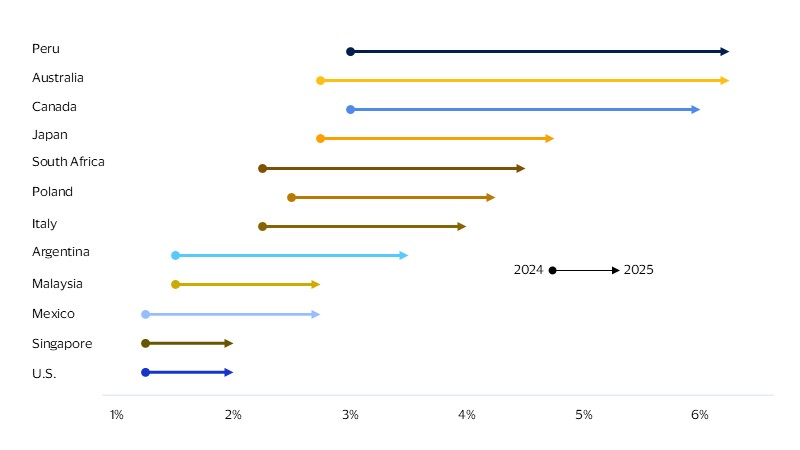
Early evidence suggests this shift may already be underway. New business formation is rising in several countries, most notably the U.S., while VisaNet data show rapid growth in AI adoption among small businesses globally (see chart below). Early adopters also show stronger spending momentum and higher levels of digital and cross-border activity. This points to a larger economic change. AI may be reshaping who becomes an entrepreneur, what digital-first small business looks like and how financial institutions serve this new generation of small and medium-sized businesses (SMBs).
AI adoption is spreading fast among small businesses globally
(Share of SMB credit cards subscribed to GenAI services,¹ percent of total active, 2025)
Millennials could drive a new wave of entrepreneurship
In the myths we tell ourselves about who builds the most successful businesses, we often latch onto the romance of young, innocent, clever founders who start their businesses in their 20s. In fact, the average founder age of the fastest-growing U.S. ventures is around 45, and relevant industry experience is strongly linked to success.² The interest is also already there: globally, 54 percent of millennials say they would love to start a business, 5 percentage points more than either Gen X or Gen Z.³
At the same time, broader forces are changing how people think about work. Careers are lasting longer, yet traditional employment feels less predictable. Alongside financial and family caregiving pressures, more people want greater flexibility and control over how they earn. Technology is helping unlock this latent entrepreneurship interest into action. Digital platforms, online payments, cloud services, and generative AI make it cheaper and easier to test an idea, reach customers, and run a business with a small team. The result could be a much broader founder base. Not just young technologists, but experienced professionals and industry experts ready to turn what they know into a business.
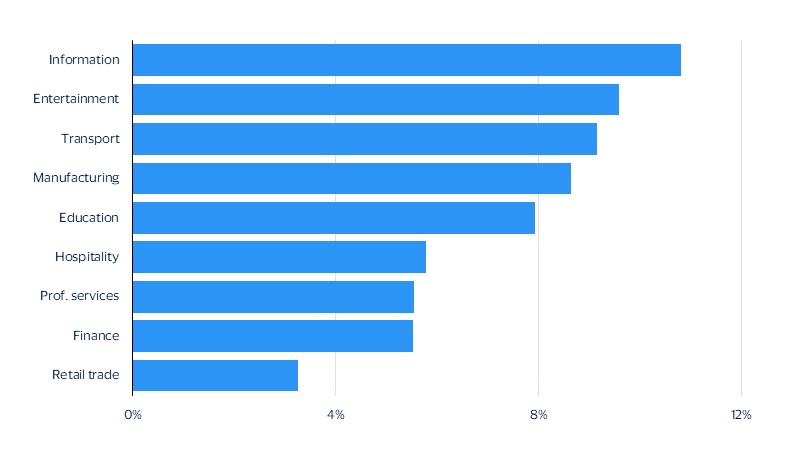
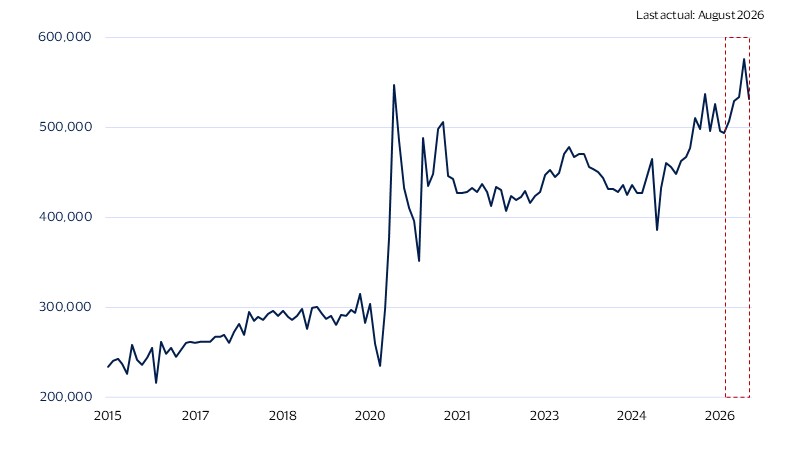
VisaNet data offer early signs of this shift. Since 2022, the share of new businesses has increased across nearly every major sector, with particularly strong gains in information and entertainment, where AI can directly support software development, design, content and marketing. Further, more recent data points to the acceleration in U.S. business applications, with similarly strong gains in the information sector (see charts below).
Information and entertainment economies are leading new business formation globally
(Change in share of new businesses in total active, ppts change between 2022–2023 and 2024–2025)⁴
Monthly business formation surging higher, likely driven primarily by AI
(Number of U.S. business applications, seasonally adjusted)
These AI-enabled small businesses are pulling ahead
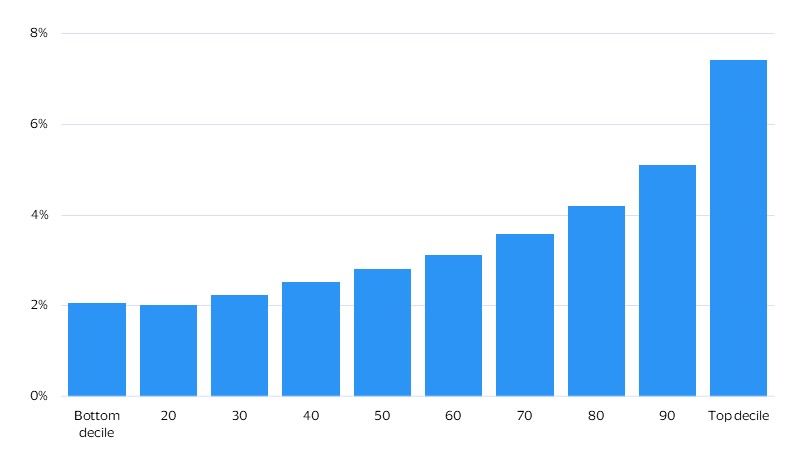
In the mainstream AI discourse, the big companies are often cast as the inevitable winners. But AI may also be giving small businesses access to capabilities that once required large teams and deep pockets. Early evidence based on VisaNet data suggests that SMBs putting AI tools to work are already beginning to stand apart. Firms in the highest spending decile are roughly three times more likely to subscribe to generative AI services than firms in the lowest spending decile (see chart below), highlighting a strong link between AI adoption and business success. Early adopters also stand out in other ways, exhibiting higher levels of digital engagement, cross-border activity, and technology-related spending, suggesting that AI is becoming part of a broader strategy to improve efficiency and expand growth opportunities.
High-spender firms are more likely to be early adopters of AI
(Share of SMB credit cards subscribed to GenAI services in 2025, by spend decile in the prior year)
Financial services need a new playbook to serve this new generation of SMBs
As we picture a small business, we often imagine a physical storefront, a team of employees and years of financial history. But broader societal and economic shifts, accelerated by AI, are producing a new generation of SMBs: younger businesses, founded by experienced professionals, that are leaner, more digital and global from the outset. Accordingly, financial institutions may need to rethink products and underwriting models built around traditional SMBs with employees, payrolls, and established credit histories.
Data, not collateral, becomes the differentiator. Many AI-enabled businesses are young, asset-light, and difficult to assess using conventional credit metrics. Recent work by Visa Consulting and Analytics⁶ highlights fragmented data as a key barrier to serving SMBs effectively. Payments data can help close that gap by providing a real-time view of business activity, cash flows, and growth trajectories.
AI adoption may emerge as a valuable signal of business momentum. Businesses using AI tools exhibit stronger spending growth and greater digital engagement than non-adopters. Combined with payments activity, these behaviors could help financial institutions deliver more targeted financing and service offerings to businesses.
The next generation of SMBs will be digital, global, and liquidity-focused. AI-enabled businesses are often born online, operate across borders, and generate less predictable revenue streams than traditional firms. This may increase demand for real-time cash flow visibility, working-capital solutions, cross-border payments, and integrated financial management tools. For financial institutions, the opportunity is not simply to serve more small businesses, but to serve a fundamentally different kind of small business.
Footnotes
- Based on anonymized and depersonalized count of small business Visa cards registering subscription payments to global and regional generative AI platforms.
- Azoulay, Pierre, Benjamin F. Jones, J. Daniel Kim, and Javier Miranda. 2020. "Age and High-Growth Entrepreneurship." American Economic Review: Insights 2 (1): 65–82.
- YouGov Global Profiles, August 2026.
- Based on anonymized and depersonalized sales transaction data across ~20M merchants from a globally representative sample of 50 markets. A merchant is classified a small and medium sized business (SMB) if its annual sales were within the bottom 75 percent of all businesses active in the same market and merchant category. A merchant is classified active if it had at least one sales transaction per month in both the current and previous years. A merchant is classified new if it was not active during the previous calendar year and became active in the current year. Chart shows percentage-point change in the average share of new merchants in total active by industry in the last two years (2024-2025) relative to 2022-2023 normal.
- Statistics Canada: “Artificial intelligence adoption and productivity in Canadian firms,” Economic and Social Report, vol 6., no. 4.
- Visa Consulting and Analytics: Reinventing SMB banking with AI, stablecoins and smarter underwriting.
Forward-Looking Statements
This report may contain forward-looking statements within the meaning of the U.S. Private Securities Litigation Reform Act of 1995. These statements are generally identified by words such as “outlook”, “forecast”, “projected”, “could”, “expects”, “will” and other similar expressions. Examples of such forward-looking statements include, but are not limited to, statements we make about Visa’s business, economic outlooks, population expansion and analyses. All statements other than statements of historical fact could be forward-looking statements, which speak only as of the date they are made, are not guarantees of future performance and are subject to certain risks, uncertainties and other factors, many of which are beyond our control and are difficult to predict. We describe risks and uncertainties that could cause actual results to differ materially from those expressed in, or implied by, any of these forward-looking statements in our filings with the SEC. Except as required by law, we do not intend to update or revise any forward-looking statements as a result of new information, future events or otherwise.
Disclaimers
The views, opinions, and/or estimates, as the case may be (“views”), expressed herein are those of the Visa Business and Economic Insights team and do not necessarily reflect those of Visa executive management or other Visa employees and affiliates. This presentation and content, including estimated economic forecasts, statistics, and indexes are intended for informational purposes only and should not be relied upon for operational, marketing, legal, technical, tax, financial or other advice and do not in any way reflect actual or forecasted Visa operational or financial performance. Visa neither makes any warranty or representation as to the completeness or accuracy of the views contained herein, nor assumes any liability or responsibility that may result from reliance on such views. These views are often based on current market conditions and are subject to change without notice.
Visa’s team of economists provide business and economic insights with up-to-date analysis on the latest trends in consumer spending and payments. Sign up today to receive their regular updates automatically via email.