Customer Segmentation Expanding consumer credit access in Asia Pacific: Infrastructure as a growth multiplier

July 2026 – Across Asia Pacific, advanced economies operate mature, well-regulated credit systems, while many emerging markets remain credit-constrained, with households still reliant on informal, fragmented, or high-cost borrowing channels. This uneven landscape represents both a policy challenge and a growth opportunity.
Using credit card ownership as a proxy for broader access to formal short-term consumer credit, new research from Visa Business and Economic Insights (VBEI) shows that credit access is necessary for inclusive growth, but insufficient on its own. Whether credit expansion generates economic value depends on the ecosystem surrounding it—merchant acceptance, credit data, responsible underwriting, consumer protection, financial literacy, and balanced regulation. Here’s what we found:
- Emerging Asia’s credit expansion has begun, but the market remains structurally underpenetrated. Rapid growth in cards per capita signals rising demand, stronger digital onboarding, and growing issuer competition. However, formal revolving credit remains out of reach for most households, with less than 10 percent of adults owning a credit card.
- Credit expansion produces different spending outcomes depending on market infrastructure. Credit expansion does not uniformly translate into higher consumption. Outcomes vary materially across markets, with merchant acceptance, payments infrastructure, and ecosystem depth shaping whether credit drives broad-based spending or remains constrained to limited use cases.
- Even modest penetration gains could unlock material economic upside. For illustration purposes, we selected four markets to analyze the impact of credit card ownership and the broader implications for their local economies. Raising credit card ownership to 10 percent across India, the Philippines, Vietnam, and Sri Lanka could bring ~70 million new consumers into the formal credit system. Under illustrative scenarios, this translates into ~USD 3.8 billion (conservative), ~USD 11 billion (base), and up to ~USD 25 billion (upside) in incremental gross domestic product (GDP).
- The upside depends on coordinated safeguards that make credit expansion both useful and responsible. Capturing the full opportunity requires aligned action across stakeholders to scale acceptance in essential categories, build consent-based data ecosystems, embed financial literacy, expand low-risk entry products, and ensure consistent regulatory standards.
The credit access gap
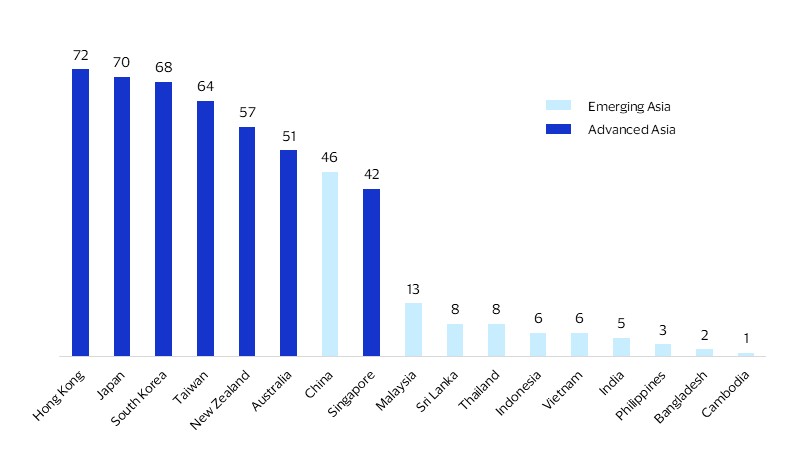
Asia Pacific’s consumer credit landscape is highly uneven. Some economies have mature, well-regulated credit markets, while others remain largely credit-starved, leaving households dependent on informal, fragmented or higher-cost borrowing channels (see figure below). This creates both a development challenge and a policy opportunity: how can emerging economies safely expand access to formal consumer credit while avoiding over-indebtedness, weak underwriting and consumer harm?
This report uses credit card ownership as a proxy for broader access to formal short-term consumer credit, including cards, installment lending, buy now pay later (BNPL) services and point-of-sale (POS) financing. The analysis finds that expanding formal credit access could support consumption smoothing, resilience and inclusive growth, but only where the necessary foundations are in place: robust credit data, responsible underwriting, consumer protection, merchant acceptance, financial literacy and effective supervision.
VisaNet spending data shows that the impact of credit expansion is not uniform. In some markets, credit appears to support spending on education, health, utilities, home improvement and travel. In others, increased credit access is associated with defensive spending or substitution across categories. This distinction is central: access to credit is a necessary but insufficient condition for growth. How credit is used, and the ecosystem around it, determines whether it translates into broader economic gains.
Credit card ownership in Asia
Percentage of adults (aged 15 and above) with at least one credit card
Why this matters for inclusive growth
Access to credit enables households to increase spending and smooth consumption, especially for big-ticket purchases or emergencies. For example, if credit-constrained consumers in India or Indonesia gain access to credit for appliance purchases or education, their spending can stimulate additional production, jobs, and income growth.
Empirical evidence supports this link. The International Monetary Fund (IMF) estimated that a 4-percentage point increase in consumer credit contribution to total credit growth raised annual real GDP growth by approximately 0.3 percentage points in emerging market economies between 2002 and 2012.¹ Moody's Analytics found that increased payment card usage contributed $245 billion to real GDP globally between 2015 and 2019, with consumption growth effects of 0.14% annually.² Although these effects are not transformational in magnitude, they are measurable and compound over time.
Expanding access to formal consumer credit can support household resilience, but it also carries material risks if the supporting infrastructure is weak. Without reliable credit data, lenders may be unable to assess affordability or monitor borrower exposure across products. Without strong consumer protection, households may face opaque fees, unsuitable products or overextension. Without broad merchant acceptance, formal credit may remain concentrated in limited use cases rather than supporting everyday consumption. And without responsible underwriting, credit growth can produce losses for lenders and debt stress for consumers rather than sustainable economic gains. Closing the gap, therefore, requires coordinated investment in infrastructure, data, financial literacy, and regulation—areas where payment networks, financial institutions, and governments each have distinct roles to play.
Emerging Asia’s credit takeoff has begun
Demand is rising from a low base
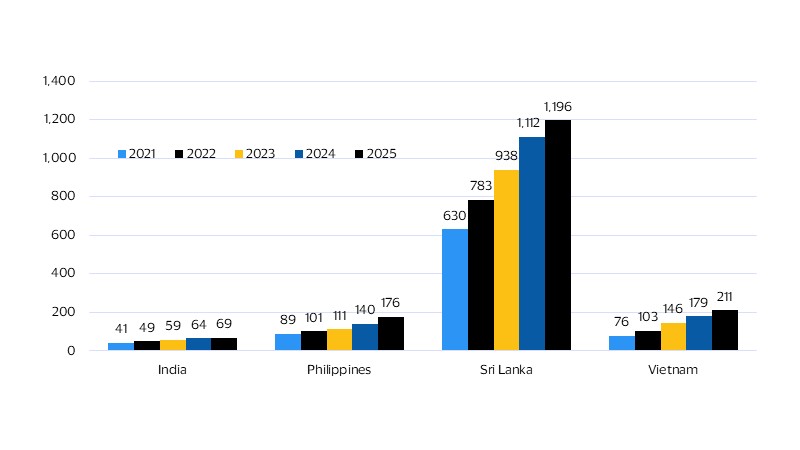
Over the past five years, consumer credit growth in emerging Asia has accelerated from a very low base, supported by post‑pandemic economic recovery, rapid adoption of digital financial services, and government-led financial inclusion initiatives. While credit cards are not the only form of consumer credit, trends in card adoption provide a useful proxy for the formalization and scaling of consumer credit usage across emerging Asia. The timeline below illustrates the sharp rise in credit card adoption across several emerging markets and highlights the scope for further expansion.
Between 2021 and 2025, the number of personal credit cards in circulation (per thousand people) increased by 67–176 percent in India, the Philippines, Sri Lanka, and Vietnam (see figure below). This expansion is not driven by population growth—adult populations in these countries grew by only around 2–4 percent over the same period—indicating a meaningful increase in the number of credit cards per person. This momentum reflects a confluence of factors: rising incomes, urbanization, smartphone penetration enabling digital onboarding, and bank/fintech competition for new customer segments.
Personal credit cards in circulation nearly doubled in selected emerging Asian economies
Cards per thousand people
The base remains small and spending is varied
Despite strong growth rates, the access gap remains substantial: credit card ownership in each of these economies is still below 10 percent, underscoring the scale of the remaining opportunity. Much of the adult population in these economies still lacks access to formal revolving credit. Also interestingly, the spending profile of each of these markets shifted very differently during this wave of credit card expansion. As new consumers gained access to credit, spending responses differed markedly across economies, reflecting differences in income levels, consumption needs, merchant ecosystems, and financial maturity.
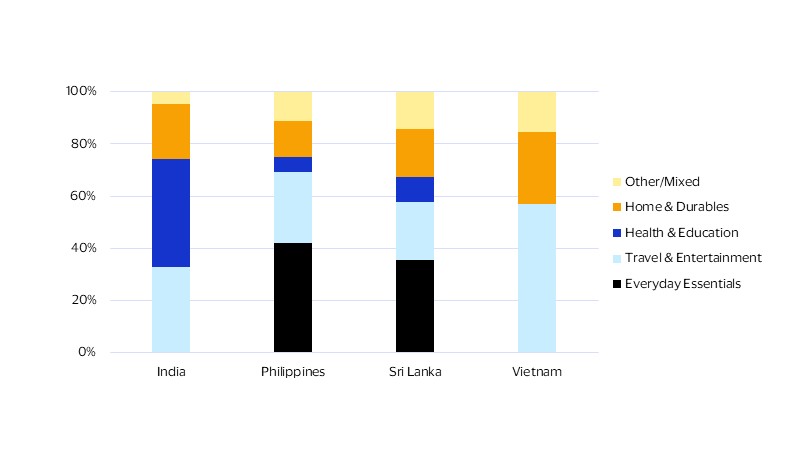
VisaNet spending data (see figure below) reveal that the impact of credit expansion is not uniform across markets. In some, credit appears to support spending on education, health, utilities, home improvement, and travel—categories that enable consumption smoothing and productivity-enhancing investment. In others, increased credit access is associated with limited category breadth or low transaction frequency, suggesting that infrastructure constraints prevent credit from integrating into daily economic life. In India, formal credit expansion correlates with increased spending on education, health, and travel—categories associated with consumption smoothing and human capital investment. In some of the other markets, spending shifts are concentrated in essential categories or substitution effects; whereas in some the impacts are mixed.
Credit expansion drives different spending patterns across markets
Share of change in credit-financed spending by category (2023–2025)
Conditions enabling high-impact credit expansion
Sizing the opportunity—an illustrative scenario
Higher formal credit access could potentially unlock up to ~USD 25 billion in GDP gains in Emerging Asia.
Context: We examined four emerging Asian economies—India, the Philippines, Sri Lanka, and Vietnam—where consumer credit adoption has accelerated in recent years, yet credit card penetration remains among the lowest globally. According to the 2024 World Bank Global Findex Survey, only 3–8 percent of adults in these markets hold a credit card, constraining access to formal credit and limiting consumer spending.
Scenario: In a simulation where credit card penetration rises from current levels to 10 percent of adults in these countries, around 70 million new cardholders would be added to the pool. The table below outlines the assumptions and estimates first-round incremental consumer spend unlocked by higher card ownership. New-to-credit cardholders typically spend 20-40 percent of what seasoned cardholders spend in their first year, due to lower credit limits, cautious usage, and unfamiliarity with credit products.3,4 This is a sizing exercise, not a forecast, designed to show the order of magnitude of potential gains if credit access expands responsibly and a portion of new credit-financed spending is genuinely incremental rather than a substitute for existing cash, debit or informal borrowing.
Risks
Risk 1: Low utilization
When merchant acceptance is limited, credit cards are issued but rarely used. Consumers hold cards for emergencies or large purchases but continue using cash or debit for daily transactions. From a lender perspective, low utilization reduces interchange revenue and increases the risk of dormancy and eventual card cancellation. From a consumer perspective, it means credit remains a niche product rather than a tool for consumption smoothing.
Risk 2: Over-extension and debt stress
Rapid credit expansion without financial literacy or affordability checks can produce over-extension. Consumers may underestimate the cost of revolving credit, take on multiple credit products without understanding cumulative exposure, or face income shocks that render debt unsustainable.
Risk 3: Substitution toward higher-cost or unregulated alternatives
When formal credit remains inaccessible, consumers shift toward informal and lightly regulated alternatives. Across markets such as India, the Philippines, and Indonesia, borrowing from family, moneylenders, or gold-backed loans is widespread due to ease of access and familiarity. However, these channels often lack transparency, carry high implicit costs, and do not build formal credit histories—limiting long-term financial access.
At the same time, rapid growth in unregulated digital credit (e.g., P2P lending and BNPL) reflects strong underlying demand but raises concerns around pricing, disclosure, and collection practices. The prevalence of these substitutes underscores a clear gap: demand for credit exists, but without scalable formal options, households rely on higher-cost, less-protected mechanisms that weaken consumer welfare and financial stability.
Safeguards
Safeguard 1: Broad merchant acceptance in essential service categories
Credit must be accepted across utilities, healthcare, education, and government services—not just retail and travel. This requires investment in POS terminals, QR code systems, and digital payment infrastructure in sectors that currently operate on cash.
Safeguard 2: Credit data ecosystems with consent-based data sharing
Lenders need access to transaction data (bank, wallet, payments) to assess risk and price credit responsibly. This requires:
- Expanding credit bureau coverage to include alternative data (utility payments, mobile money, digital wallet transactions)
- Regulatory frameworks that enable consent-based data sharing while protecting privacy
- Interoperability between bank, fintech, and payment network data systems
Safeguard 3: Consumer protection and financial literacy
Clear fee disclosures, mandatory affordability checks, and dispute resolution mechanisms are essential. Equally important are financial literacy programs that explain credit terms, interest calculation, repayment obligations, and responsible usage.
Safeguard 4: Clear and balanced regulation
Regulatory frameworks should:
- Encourage innovation (sandboxes, proportional regulation for fintechs)
- Protect consumers (fee transparency, dispute resolution, data privacy)
- Prevent regulatory arbitrage (ensure BNPL, P2P, and traditional credit face comparable consumer protection standards)
- Promote interoperability (credit reporting, data sharing, cross-platform acceptance)
Implications for policymakers and industry stakeholders
Five coordinated actions for policymakers, regulators, financial institutions, and infrastructure providers to scale credit access responsibly and unlock $25 billion in GDP growth potential.
First, expanding merchant acceptance—particularly in essential categories such as utilities, healthcare, education, and public services—is critical to embedding credit into everyday transactions. Targeted incentives, public-private partnerships, and government mandates can accelerate acceptance, enabling more frequent and habitual credit usage beyond discretionary spending.
Second, building robust, consent-based credit data ecosystems will allow lenders to serve thin-file and new-to-credit segments more effectively. Integrating alternative data sources—such as payments, utilities, and digital wallet activity—into underwriting frameworks can materially expand the addressable market while improving risk pricing.
Third, this must be complemented by embedding financial literacy at the point of product onboarding, ensuring consumers understand credit terms and use products responsibly, thereby strengthening trust and reducing delinquency risks.
Fourth, targeted product innovation—particularly secured and co-branded credit solutions—provides practical entry points for underserved segments. Deposit-backed cards, salary-linked credit lines, and wallet-integrated products lower barriers to entry while maintaining prudent risk profiles.
Finally, regulatory alignment is essential to ensure that innovation in BNPL, P2P lending, and digital credit is supported by consistent consumer protection standards, transparent reporting, and integration into formal credit systems.
Together, these actions form an integrated roadmap: Scaling acceptance to enable usage, leveraging data to expand access, building capability to sustain responsible behavior, innovating products to reach new segments, and aligning regulation to safeguard the system. Executed in tandem, they can convert latent demand into sustainable credit expansion—unlocking an estimated ~USD 25 billion in incremental GDP in emerging Asia while advancing financial access and stability.
Footnotes
- IMF, Credit Expansion in Emerging Markets: Propeller of Growth?, p. 11
- Moody’s Analytics, The Impact of Payment Cards on Economic Growth, p. 12, 19
- Gross & Souleles 2002, Credit Cards and Consumption
- TransUnion, New-to-Card Consumers Key to Driving Inclusive Credit Growth in the Philippines
- Average annual spend calculated from VisaNet transaction data for consumer credit cards in India, Philippines, Vietnam, and Sri Lanka (2023–2025). Figures represent total purchase volume divided by active card count (cards with ≥1 transaction per year)
- These estimates assume a 1.0x GDP multiplier (i.e., $1 of new credit spending = $1 of GDP). This is largely in line with baseline consumption devoid of leakages and risks with potential upside if credit finances durable goods or services that generate downstream production.
Forward-Looking Statements
This report may contain forward-looking statements within the meaning of the U.S. Private Securities Litigation Reform Act of 1995. These statements are generally identified by words such as “outlook”, “forecast”, “projected”, “could”, “expects”, “will” and other similar expressions. Examples of such forward-looking statements include, but are not limited to, statements we make about Visa’s business, economic outlooks, population expansion and analyses. All statements other than statements of historical fact could be forward-looking statements, which speak only as of the date they are made, are not guarantees of future performance and are subject to certain risks, uncertainties and other factors, many of which are beyond our control and are difficult to predict. We describe risks and uncertainties that could cause actual results to differ materially from those expressed in, or implied by, any of these forward-looking statements in our filings with the SEC. Except as required by law, we do not intend to update or revise any forward-looking statements as a result of new information, future events or otherwise.
Disclaimers
The views, opinions, and/or estimates, as the case may be (“views”), expressed herein are those of the Visa Business and Economic Insights team and do not necessarily reflect those of Visa executive management or other Visa employees and affiliates. This presentation and content, including estimated economic forecasts, statistics, and indexes are intended for informational purposes only and should not be relied upon for operational, marketing, legal, technical, tax, financial or other advice and do not in any way reflect actual or forecasted Visa operational or financial performance. Visa neither makes any warranty or representation as to the completeness or accuracy of the views contained herein, nor assumes any liability or responsibility that may result from reliance on such views. These views are often based on current market conditions and are subject to change without notice.
Visa’s team of economists provide business and economic insights with up-to-date analysis on the latest trends in consumer spending and payments. Sign up today to receive their regular updates automatically via email.